

Understanding basic math terms is a lot like learning how to care for a new pet: once you understand what something is, how it behaves, and where it shows up, everything becomes much easier. One such important math term is quotient.
The word quotient may sound technical or intimidating at first, but it’s actually one of the most common and useful ideas in mathematics. You’ve likely encountered it many times without realizing it—especially when dividing numbers.
In this guide, we’ll gently and thoroughly explore what a quotient means in math, how it works, where it appears, and how to recognize it in real life. Think of this as a calm, step-by-step care manual for understanding quotients—no rushing, no stress.
What Does Quotient Mean in Math?
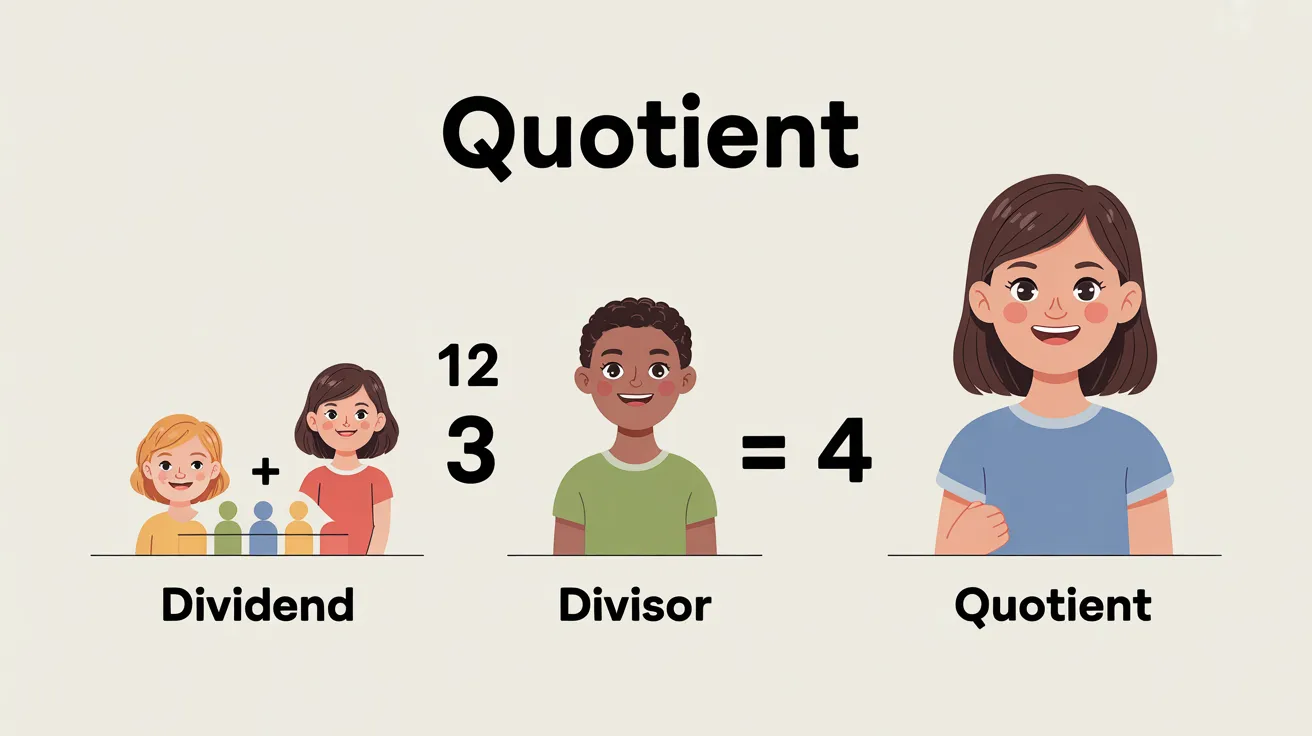
In mathematics, a quotient is the result you get when one number is divided by another.
Simple Definition
Quotient = the answer to a division problem
For example:
- 12 ÷ 3 = 4
- The number 4 is the quotient
Just as a veterinarian might define a condition in simple terms before going deeper, this is the core idea you should always remember.
Breaking Down the Word “Quotient”
The word quotient comes from the Latin word quotiens, meaning “how many times.”
When you divide numbers, you are essentially asking:
- How many times does this number fit into another?
Example
- 15 ÷ 5 = 3
- This asks: How many times does 5 fit into 15?
- Answer: 3 (the quotient)
Parts of a Division Problem (The Quotient’s Family)
Just like animals live within ecosystems, the quotient exists within a division system. To understand it properly, you should know the other parts too.
Key Parts of Division
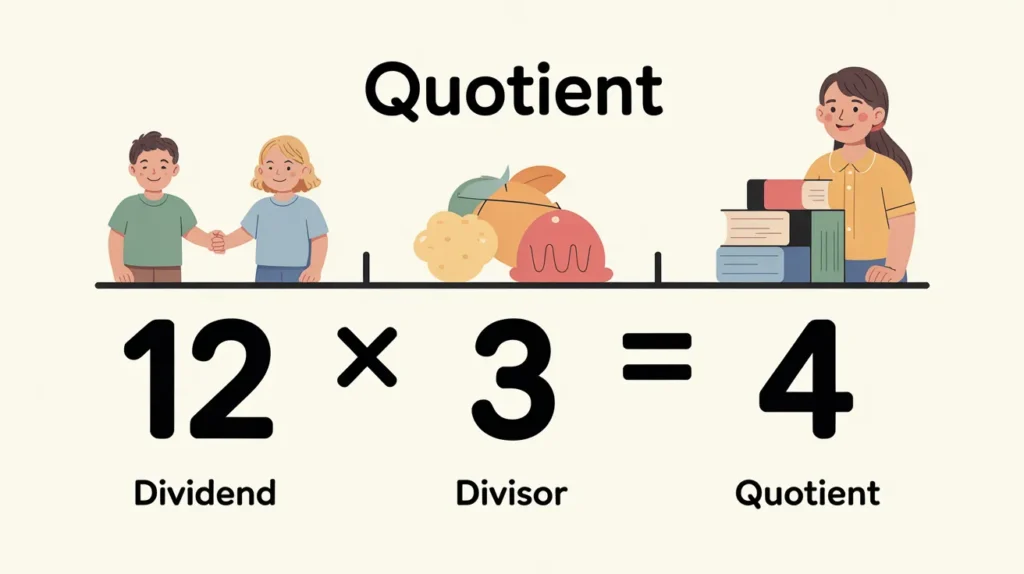
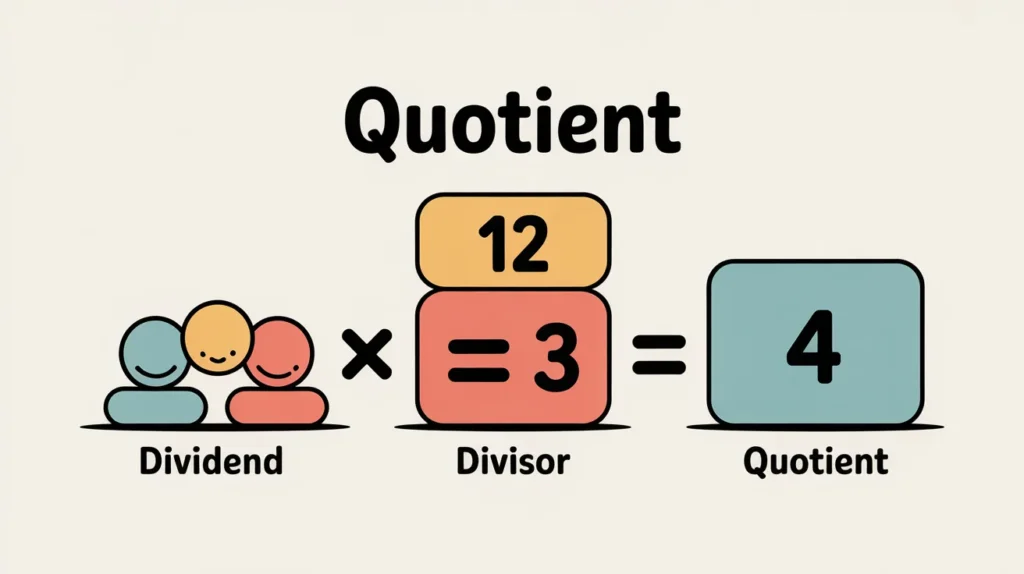
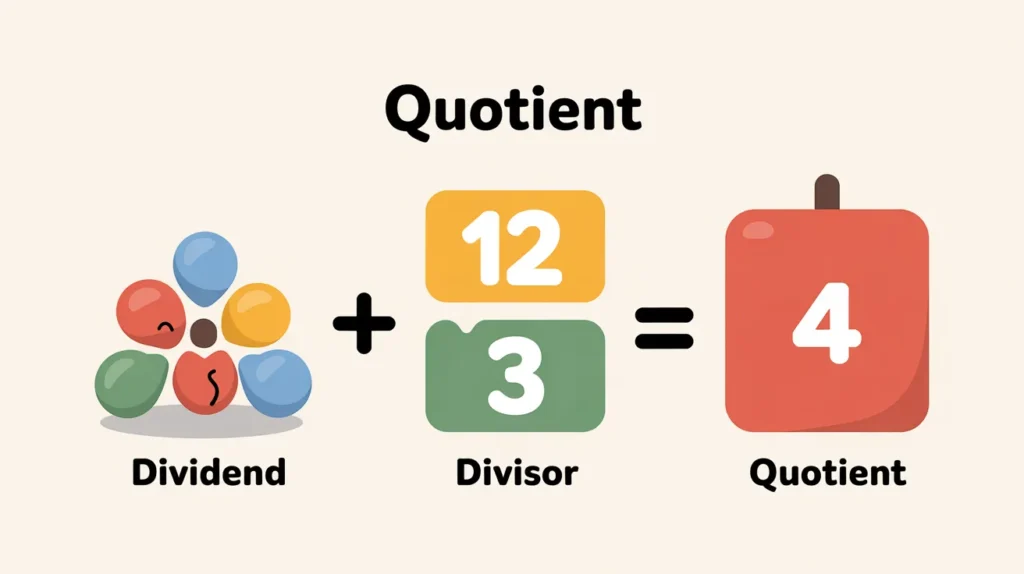
- Dividend – the number being divided
- Divisor – the number you divide by
- Quotient – the result
- Remainder – what’s left over (if anything)
Visual Example
20 ÷ 4 = 5
↑    ↑   ↑
Dividend Divisor Quotient
Types of Quotients in Math
Quotients come in different “species,” depending on the type of division involved.
1. Whole Number Quotient
This is the simplest and most common type.
Example:
- 18 ÷ 6 = 3
No leftovers, no decimals—clean and tidy.
2. Quotient With a Remainder
Sometimes division doesn’t come out evenly.
Example:
- 17 ÷ 5 = 3 remainder 2
Here:
- Quotient = 3
- Remainder = 2
This is common in early math learning.
3. Decimal Quotient
When division continues beyond whole numbers, you get decimals.
Example:
- 10 ÷ 4 = 2.5
Decimal quotients are very common in measurements, money, and science.
4. Fractional Quotient
Sometimes the quotient is written as a fraction.
Example:
- 1 ÷ 4 = 1/4
This type appears often in algebra and ratios.
Quotient in Long Division
Long division is where the quotient really shows its behavior clearly.
Example: 154 ÷ 7
Step by step, the number you write on top of the division symbol is the quotient.
   22
7 |154
- Quotient = 22
Think of long division as a careful feeding routine—slow, structured, and precise.
Quotient in Algebra
As students grow, quotients don’t disappear—they just evolve.
Example With Variables
- x ÷ 4 = x/4
Here, x/4 is the quotient.
In algebra:
- Numbers
- Variables
- Expressions
…can all form quotients.
Quotient vs Remainder: Knowing the Difference
These two are often confused, especially by beginners.
Quick Comparison
| Term | Meaning |
|---|---|
| Quotient | The main result |
| Remainder | What’s left over |
Example
- 29 ÷ 6 = 4 remainder 5
- Quotient = 4
The quotient is always the primary answer.
Real-Life Examples of Quotients
Quotients aren’t just classroom creatures—they live all around us.
Everyday Scenarios
- Sharing food:
12 cookies ÷ 4 kids = 3 cookies each (quotient) - Money:
$100 ÷ 5 people = $20 per person - Time:
60 minutes ÷ 3 tasks = 20 minutes per task
If you’ve ever split anything evenly, you’ve used a quotient.
Visual Cues to Recognize a Quotient
Just like physical symptoms help identify an animal’s condition, math has visual signs too.
Common Visual Clues
- Division symbol (÷)
- Fraction bar (/)
- Long division bracket
- Words like:
- “per”
- “each”
- “split evenly”
- “shared among”
When you see these, a quotient is nearby.
Common Student “Symptoms” of Quotient Confusion
Learners sometimes struggle with quotients. Here are common signs:
Warning Signs
- Mixing up quotient and divisor
- Thinking the quotient is always bigger
- Forgetting decimals or remainders
- Avoiding word problems
Gentle Treatment Tips
- Draw pictures
- Use real objects (coins, blocks)
- Practice with small numbers
- Say the division aloud
Quotient in Word Problems
Word problems often hide the quotient inside stories.
Example
Problem:
“A farmer has 24 apples and packs them equally into 6 baskets. How many apples are in each basket?”
Solution:
- 24 ÷ 6 = 4
- Quotient = 4 apples per basket
Always look for “each” or “per”—they signal a quotient.
Quotient in Advanced Math
As math matures, quotients remain active.
Where They Appear
- Ratios
- Rates
- Slopes (rise ÷ run)
- Probability
- Calculus limits
Even in advanced math, a quotient is still about division and comparison.
Where “Quotient” Can Be Found or Live
Although a quotient isn’t a living creature, it inhabits specific mathematical environments, much like animals live in habitats.
Natural Habitats of Quotients
- Classroom math lessons
- Word problems
- Algebraic equations
- Fractions and ratios
- Real-world problem solving
- Science formulas
- Economics and finance
- Engineering calculations
Host Environments
- Textbooks
- Worksheets
- Exams
- Spreadsheets
- Calculators
If numbers are being divided, the quotient is living there comfortably.
Practical Tips for Mastering Quotients
Like caring for a pet, consistency matters.
Helpful Tips
- Practice daily with small problems
- Say “divided by” out loud
- Use visual models
- Check answers by multiplying back
- Don’t rush—accuracy beats speed
Quotient vs Product: Don’t Confuse Them
These two are opposites.
| Term | Operation |
|---|---|
| Quotient | Division |
| Product | Multiplication |
Remember:
- Division gives quotients
- Multiplication gives products
Why Understanding Quotients Matters
Quotients are foundational. Without them:
- Fractions don’t make sense
- Ratios fail
- Rates collapse
- Algebra becomes confusing
They are a core survival skill in math.
Common Questions About Quotients
People often ask similar things when learning this concept.
Is the quotient always smaller?
Not always.
- 10 ÷ 2 = 5 (smaller)
- 10 ÷ 0.5 = 20 (larger)
It depends on the divisor.
Can a quotient be negative?
Yes.
- −12 ÷ 3 = −4
- 12 ÷ −3 = −4
Can zero be a quotient?
Yes.
- 0 ÷ 5 = 0
But zero cannot be a divisor.
Frequently Asked Questions (FAQ)
1. What does quotient mean in simple words?
A quotient is the answer you get when you divide one number by another.
2. Is a quotient the same as a fraction?
A fraction can represent a quotient, but not all quotients are written as fractions.
3. Where do we use quotients in real life?
Quotients are used when sharing, measuring, budgeting, cooking, traveling, and analyzing data.
4. Can a quotient include decimals?
Yes. Many quotients are decimals, especially in real-world problems.
Final Thoughts
Understanding what a quotient means in math doesn’t require fear or memorization. Like learning how to care for a pet, it simply requires patience, repetition, and familiarity.
Once you know:
- What it is
- Where it lives
- How it behaves
…the quotient becomes a friendly and reliable tool you’ll use for life.